
Summary: This guide covers everything beginners and SEO professionals need to know about meta tags — what they are, the main types (title, description, robots, canonical, Open Graph, and more), how to write and check them, and the most common mistakes to avoid. It includes simple HTML examples and two quick-reference tables for easy scanning.
Meta Tags for SEO: What They Are, Why They Matter, and How to Use Them
Html Meta Tags | Meta Elements | CTR
Introduction
Think about all the instances in which you have attempted to search for something through Google, only to end up clicking on the link with the identical name and description. That is correct; you were using SEO meta tags in instances such as this one. Specifically, a meta tag is a specific part of HTML coding that doesn’t appear anywhere on your website; however, it’s the most critical part in determining how your webpage is presented through search engines and on social media and how your webpage is perceived by search engines.
While the use of SEO meta tags might be considered an extremely technical matter which concerns only the web developers, once you know the reason behind their usage, you will realise how easy it is.
Quick Response: Meta tags are basically HTML tags present in the header section of a website page. However, they cannot be viewed by users and are instead read by search engines and social networking websites. Some of the important meta tags in SEO include the title tag, meta description, robots tag, and canonical tag; notably, these don’t directly help with ranking but influence CTR and indexing of web pages.
What Are Meta Tags?
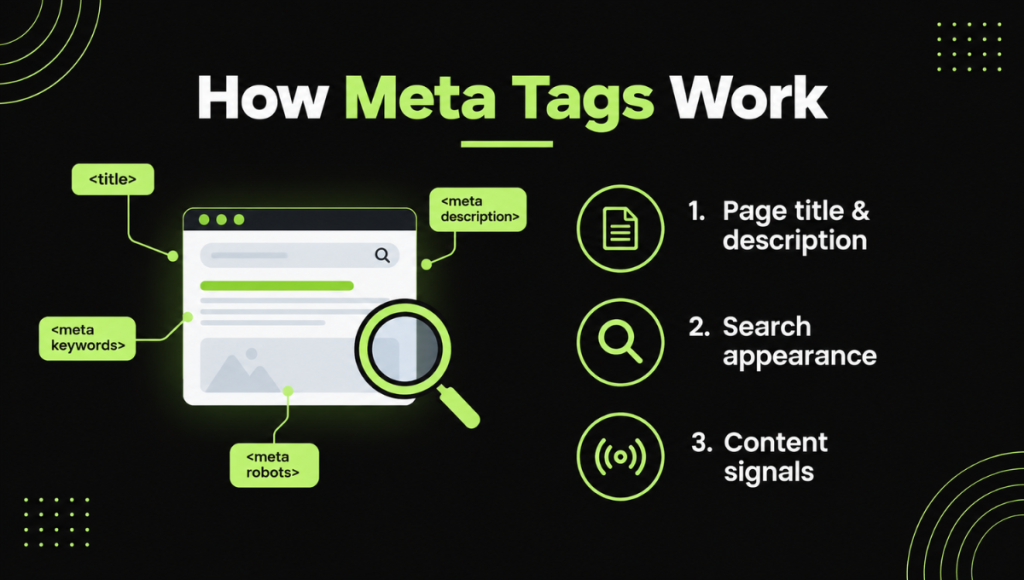
Thus, a meta tag is simply an HTML tag located inside the head tag of the website. Meta tags do not display themselves anywhere on the web page; instead, they contain all the information about the web page for browsers and search engines.
Meta tags operate behind the scenes. When the process of crawling your web page takes place, the search engines scan the meta tags and receive all the information like the title of the web page, the description of the content, etc. Though the user cannot see the code, what they will see is the effect of the meta tags, which can be seen as a blue clickable title and description box on the search results page.
To sum up, all the meta tags in HTML are signals. They can be signals for search engines, they can be signals for social networking sites, and finally, there are informational signals.
Why Are Meta Tags Important for SEO?
Meta tags are important because they influence the appearance of your pages and how the search engines interpret them despite the fact that they do not influence the ranking of your pages.
Ways Meta Tags Improve Your SEO Performance
- Furthermore, appearing in search engine results—good meta tags help search engines categorise and display your pages the right way.
- Click-through rate – A good title and description will ensure people click on your link rather than those of your competitors.
- Appearance of snippets – They determine how titles and other snippets will appear in the search results.
- Additionally, crawling and indexing—some meta tags tell search engines how to crawl and index your pages.
- Social Networking – They determine how your pages will be shared on social networking sites like Facebook and LinkedIn.
It must be noted that some meta tags do not influence the ranking of Google at all. Some are ranking factors like title tags while others are not ranking factors like meta keywords.
Types of Meta Tags
1. Title Tag
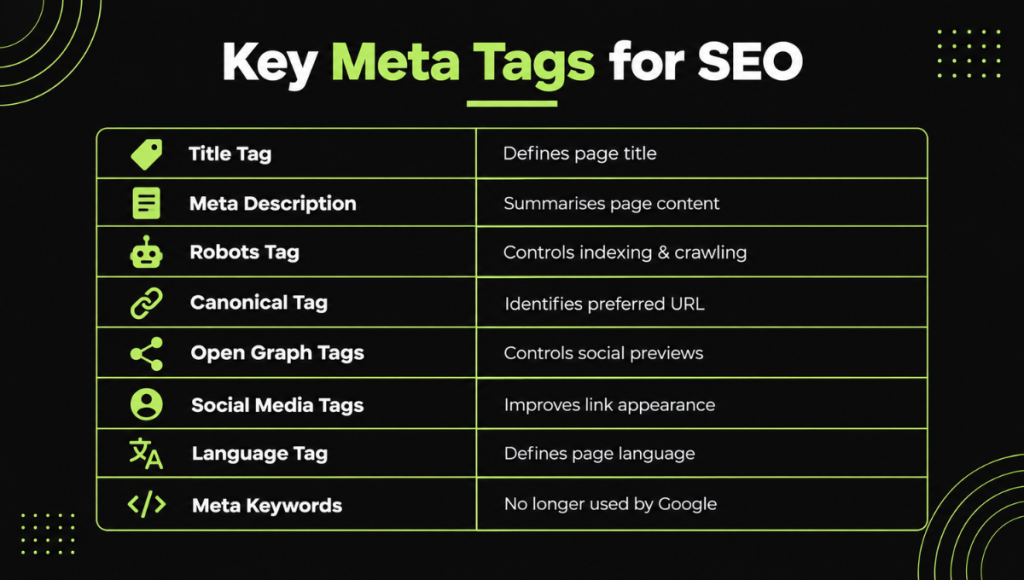
Without any shadow of a doubt, the title tag is the most significant meta tag when it comes to SEO optimisation. It’s used to specify the title text shown in the SERP. Specifically, the title tag must be clear, include the main keyword, and reflect the page’s content. Besides, it should consist of approximately 50–60 characters.
2. Meta Description
The meta description provides a brief summary of the page’s content. Although it doesn’t directly influence the page’s ranking, a good meta description nevertheless increases CTR by giving users a reason to click. Learn everything about what SEO is from our full guide on SEO.
3. Robots Meta Tag
A robot meta tag gives information for search engines whether they should index the page and follow its links. For example, the robot meta tag may be used when one wants his/her thank you page to not be indexed by the search engine.
4. Canonical Tag
A website may sometimes have several pages with the same or duplicated content. for example, a product page with multiple URLs. In such cases, the canonical tag helps inform search engines which page is the correct one.
5. Open Graph Tags
The Open Graph Tags help to tell how your web pages are going to be displayed when shared on social networking sites such as Facebook and LinkedIn. This is because the tags provide information about your posts — such as the page name, description, and image — that will be displayed. In the absence of these tags, the social media sites will use some information at random.
6. Social Media Meta Tags
There are other social media meta tags besides Open Graph Tags. An example of this meta tag would be that of the Twitter Card Tags, which enable you to determine how the content of your posted links looks on Twitter.
7. Language Meta Tag
A language meta tag is used by you to identify the language in which the development of your website has been done. In this way, the information is displayed in your right language by your browser or translator.
8. Meta Keyword Tags
Meta keyword tags were one of the tags used by the search engines in the past to determine the keywords that were meant for the particular web page. However, today, the major search engines such as Google have stopped using the meta keyword tags.
| Meta Tag | Purpose | SEO Importance |
| Title Tag | Page title definition | High |
| Meta Description | Page summary | Improves CTR |
| Robots Meta Tag | Indexing is controlled. | Technical SEO essentials |
| Canonical Tag | URL identification | Essential for duplicate URLs |
| Open Graph Tags | Controls social media previews | Improves link appearance when shared |
Meta Tags in HTML
Here are simple, beginner-friendly examples of common meta tags in HTML:
html
<title>Best Running Shoes for Beginners | YourBrand</title>
<meta name=“description” content=“Discover the best running shoes for beginners, with comfort, durability, and price compared side by side.”>
<meta name=“robots” content=“index, follow”>
<link rel=“canonical” href=“https://www.yourwebsite.com/best-running-shoes”>
<meta property=“og:title” content=“Best Running Shoes for Beginners”><meta property=“og:description” content=“Compare top running shoes for new runners.”><meta property=“og:image” content=“https://www.yourwebsite.com/images/running-shoes.jpg”>
These examples show how compact and readable meta tags are once you see them in context.
How to Create Effective Meta Tags
The generation of meta tags is not the same as keyword spamming; it means relevance and clarity. Below are some tips on how to make meta tags properly:
- Understand the search intent. The title and description should match the search intent of the user.
- Use proper keywords. Remember that you should use keywords appropriately.
- Each page must have its own title and description. Otherwise, it will be very confusing for both the user and the search engine.
Final Tips for Better Metadata
It is always important to make sure that your content is concise at all times. This is because it would be unwise to create any kind of verbose content since this would affect the quality of your content. Repetition of the keyword is also discouraged since it may be considered spamming.
Keyword research and analysis makes this very easy. All that needs to be done is to find the long-tail keywords, and it will make things very easy for you.
How to Check Meta Tags
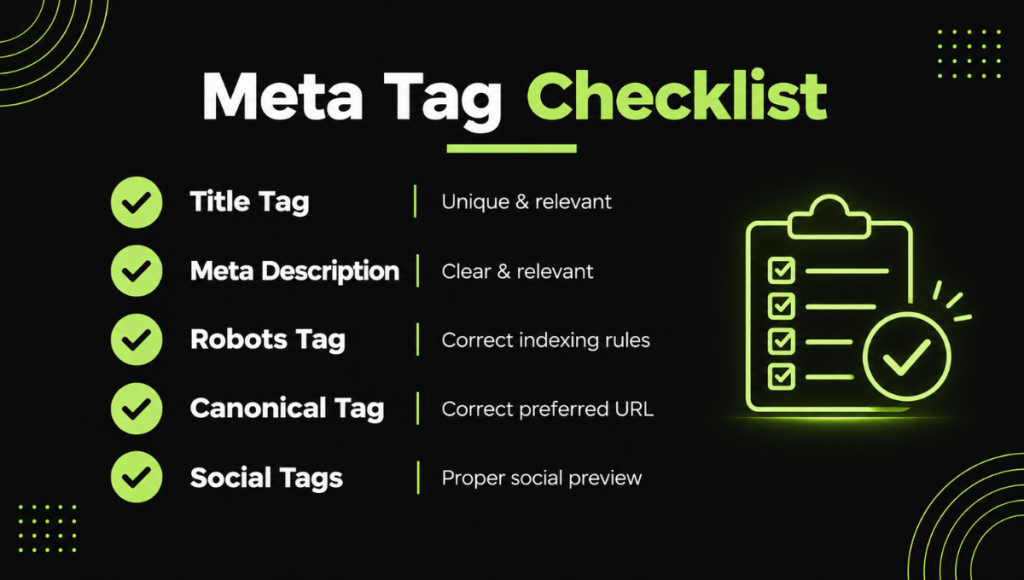
After your meta tags have been implemented, it becomes imperative that you check whether they are functioning efficiently.
Key Things to Check
- Title tag (Is it unique & relevant?)
- Meta description (Is it relevant?)
- Robots directive (Are there pages restricted from being indexed?)
- Canonical tag (Is the URL correct?)
- Social metadata (Does it preview properly?)
What Is a Meta Tag Generator?
Meta Tag Generator is basically a piece of software that allows you to create some elementary HTML tags on the basis of just a few parameters, like, say, the title of the page, its description and keywords. This kind of software can prove to be quite helpful for those who are not very confident while creating their HTML tags.
Remember that whatever the output created by the generator, it won’t be of much use to you as it is. You need to check if the tags generated by the software meet your website’s needs.
Meta Tags and Modern SEO
However, meta tags don’t operate by themselves; they are just part of a much bigger SEO system. For instance, for more information on how all these work together, check out our beginner’s guide to on-page SEO. In addition to the proper use of metadata, the current SEO system also involves.
The analysis of the user intent behind each search query
- Keyword research
- Content optimisation
- CTR improvement using good snippets
- Technical SEO
AEO updates matter because AI and featured snippets will increasingly handle searches in the future
And in this new era of search techniques, the meta tags remain important but only alongside quality content and website design.
Common Mistakes and How to Fix Them
| Common Mistake | Why It Is a Problem | How to Fix It |
| Duplicate title tags | Pages may appear less distinct. | Write unique titles. |
| Keyword stuffing | Creates poor-quality metadata | Use keywords naturally. |
| Missing meta description | Search engines may create their own snippet. | Add a relevant description. |
| Incorrect canonical tag | Can confuse search engines | Use the correct preferred URL. |
To be specific, when there is any misuse of robots directives, then it results in the indexing of websites by the search engines. Similarly, misuse of canonical tags makes it confusing for the search engine to rank the right URL. To know whether you have this problem on your website, Digital Usman’s SEO consultancy can help you.
Why Trust Digital Usman for Your SEO Needs
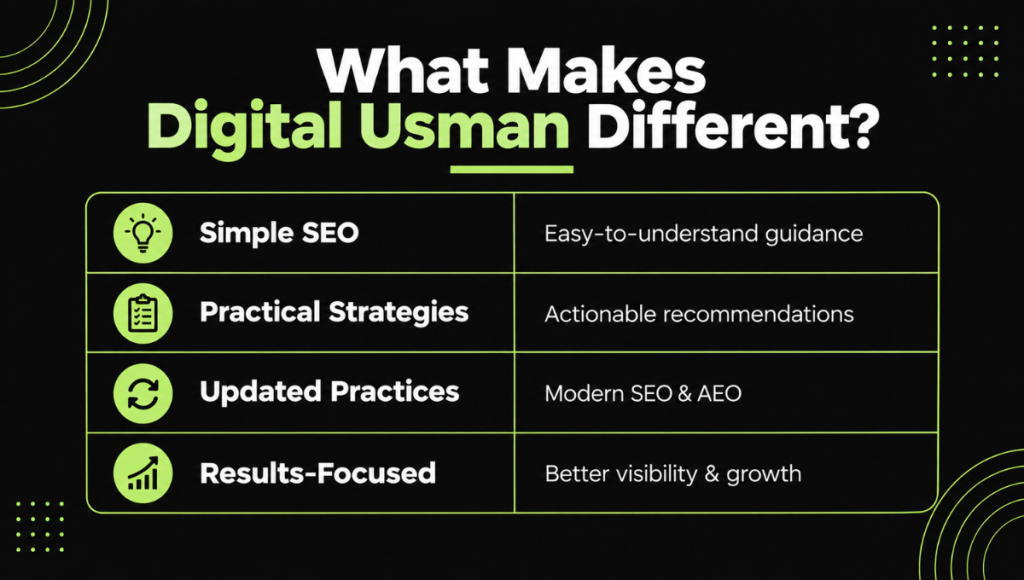
There are plenty of articles on SEO, most of which can contradict each other, making you doubt whether what you read is correct. However, at Digital Usman, SEO means being easy, simple and result-orientated, paying attention to basics, such as meta tags, which many people ignore but work miracles.
How does he differ from other people?
- Friendly attitude towards users – We give you SEO advice without overwhelming you with lots of technical terminology.
- Useful recommendations – All tips given by us are applicable.
- Up-to-date SEO practices – We are aware of current trends and incorporate AEO into our strategy, along with other practices.
- Result-orientated approach – Our goal is achieving better visibility and growing with the help of SEO.
This article aims at proving you the logic behind our SEO tips.
Conclusion
Even though the tags themselves are invisible, their role when it comes to the discovery, interpretation, and distribution of your website cannot be overlooked. Indeed, from title tags that attract people to your website by promising a good click-through rate from search results to Open Graph tags that ensure your content looks professional on social media platforms, these little bits of data will bring you huge benefits to your SEO efforts as a whole.
However, not everything can be done with meta tags, and not all meta tags influence your rankings directly. Nevertheless, if you use them the right way along with keyword research and quality content, they will definitely help your website a lot. Need assistance in improving the SEO of your site? Then get in touch with Digital Usman today.