
Summary: Market research helps businesses understand their customers, competitors, and industry trends. This guide covers the main types of market research, popular methods, practical examples, and how digital tools and AI support better business decisions.
What Is Market Research? Methods, Benefits, and Examples
Primary Research | Qualitative Research | Concept Testing
Any successful business starts with a single question: what does our customer want? First of all, taking a guess could be costly. Instead, market research provides the facts to replace the guesswork.
Market research is the collection and analysis of information on customers, competition, and trends in the market to aid decision-making. Moreover, it helps you answer important questions. For instance, who is buying this? What do they want? What options are the competitors offering? Finally, what are the future trends in the market?
In fact, you may already be doing it by default. For example, when a bakery tries out a new item from its menu, or when a software firm asks customers for feedback on a new product feature, both are carrying out market research. Therefore, this guide explains market research, including its types, methods, and the process step by step.
Answer: Market Research can be described as the process of collecting and analysing data about the target market, competitors, and trends prevailing in the industry so that the decision-making process can be informed by the collected data. The process uses primary as well as secondary research. It is effective when the goals of research, target market, and research methods are clear.
Why is Market Research Important?
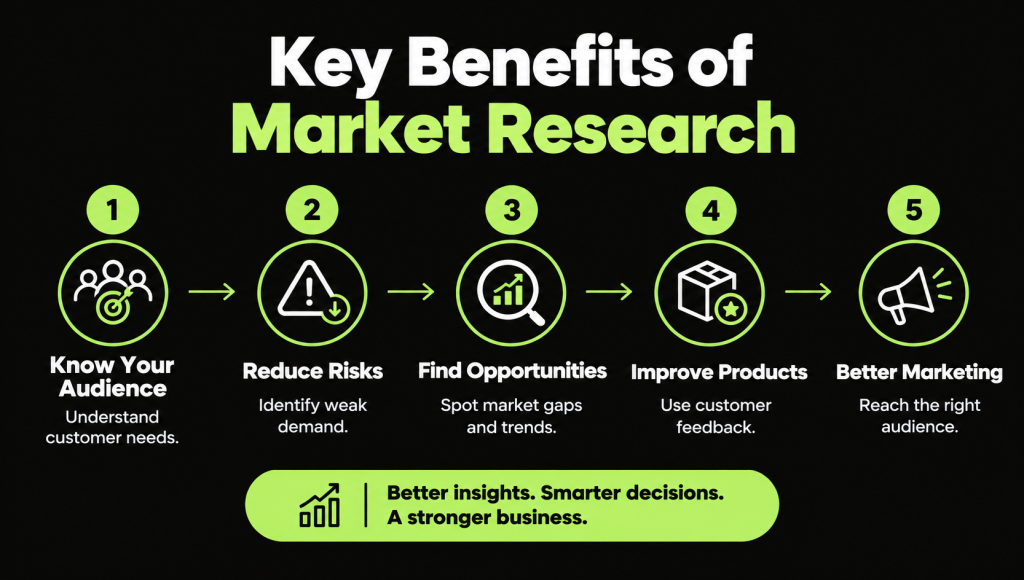
Advantages of market research are related to the possibility of taking decisions with lower risks. Instead of taking
a decision by feeling, companies have a chance to confirm their decisions by customer feedback and numbers. Here are some reasons why market research helps:
- Know your target audience: Their age, location, interests, budget, and problems will help you to make better products and marketing strategies.
- Lower risks: It is much cheaper to learn about weak demand before product introduction rather than after it.
- Find new opportunities: Absence of certain products from the competitors, changes in customer behaviour, or new trends may provide you with information about new products and niches.
- Improve current products: Customer feedback will show what needs to be improved.
- Develop efficient Digital Marketing Strategies: You will know where to find your audience online, what keywords they use and what persuades them. See how this fits into the wider picture in our guide to the types of digital marketing.
What Are the Main Types of Market Research?
Market research is usually categorised based on the sources of the information. It can be classified into two types – primary research and secondary research. Good research always uses both of them.
Primary Research
Primary research means collecting data for the first time, directly from the source. In this case, you ask the questions, choose the interviewees, and draw conclusions based on your own results. Moreover, primary research methods may include online surveys, personal interviews, focus group interviews, and observation of people’s behaviour in the store or on the Internet.
The major advantage of primary research is its relevance to your research question. However, it also has a disadvantage: it takes a lot of time and effort.
Secondary Research
Secondary research, on the other hand, uses data that already exists. For example, it may draw on industry reports, publications from the government or academic institutions, statistics from a trade organisation, or reliable online sources. As a result, it is a relatively inexpensive and quick way to figure out market sizes, competitor positions, and trends before primary research is conducted.
However, secondary research has a limitation. Since the data was not made specifically for you, it may not fit your exact needs. Besides that, it could be out of date, so it is wise to check the publication date before relying on it.
Primary vs Secondary Research: Which One Fits Your Business?
| Aspect | Primary Research | Secondary Research |
| Data sources | First-hand data collected by you | Data published by others |
| Common approaches | Surveys, interviews, focus groups, observation | Industry, government, and research reports; reliable online sources |
| Cost | Higher | Lower, often free |
| Speed | Slower | Faster |
| Relevance | Exactly what you need for your questions | May be general or out of date |
| Best used for | Learning more about your customers | Building background knowledge of the market |
Common Market Research Methods
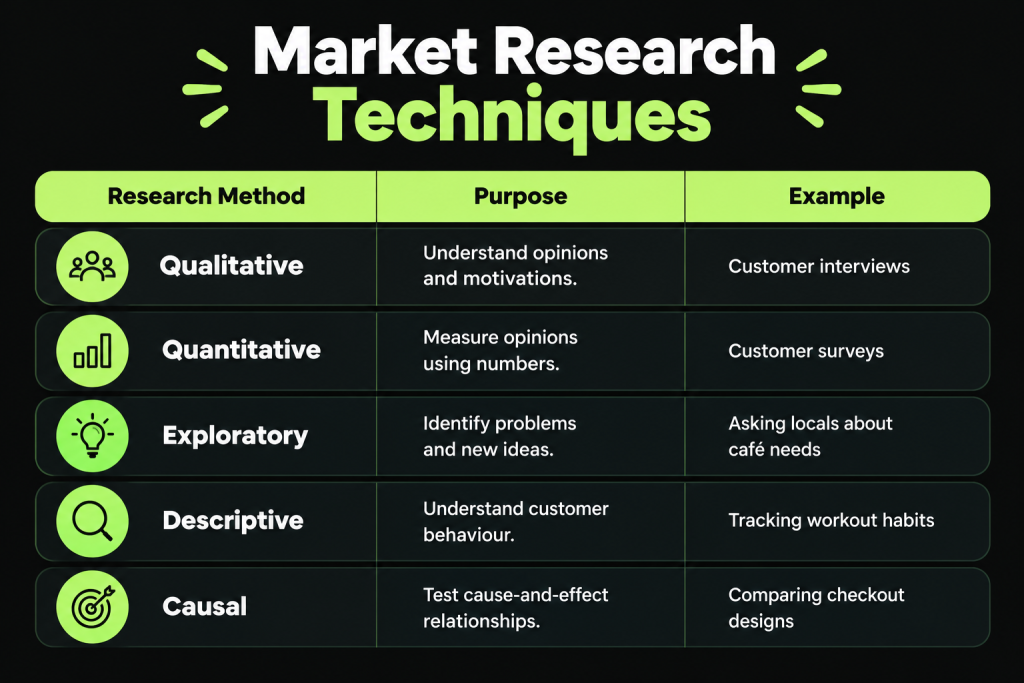
Marketing research techniques depend on the information that should be acquired. While some of them are used to find out the cause of the action, others focus on the scale of the action or opinion.
Qualitative Research
Qualitative research focuses on people’s views, emotions, and motivations. Instead of counting responses, however, it tries to find out the reason behind those opinions and attitudes. Interview, focus groups, survey questions which do not have multiple-choice answers, and consumers’ reviews are examples of qualitative research.
For instance, if there is a drop in online purchases of the skincare product, it can be clear after several interviews that the clients get puzzled about its package. This type of answer cannot be revealed from a spreadsheet. Qualitative research is best applied at the beginning of the project.
Quantitative Research
Quantitative research is all about numbers. It uses surveys, polling, and statistics in an attempt to determine how prevalent certain opinions or behaviours are within a wider population. The questions used are often close-ended, like rating scales or multiple-choice questions.
In the event that qualitative research reveals that your customers are dissatisfied with your packaging, you could use quantitative research to determine just how many people are of the same opinion and what age group they belong to.
Exploratory, Descriptive and Causal Research
The researchers divide the studies into groups according to the goal they pursue. Every type answers a certain question:
- Exploratory research investigates the problem, which is poorly defined. For example, the owner of a new café can ask the locals about things they do not like in existing cafes.
- Descriptive research investigates and describes the situation as it is at the moment. A fitness company can conduct a survey to find out how many times the members work out and what classes they prefer.
- Causal research investigates whether one factor affects the other one. The online store can show two different versions of the checkout to the visitors to see which one brings more transactions.
How to Conduct Market Research Step by Step
The clarity of the process will help us stay on course and not lose time. The following is the list of steps that can be used by any business.
Define Research Objectives
First of all, figure out what it is that you need to find out. Defining research objectives will help turn the abstract goal of “learning about our clients” into a concrete goal, like “why do first-time buyers abandon their shopping cart?” All good research objectives are specific, measurable and related to the decision-making process.
Identify Your Target Audience
Now, determine whom you wish to hear from. Consider their demographical details, like their age, salary level, and place of residence, among other factors like interests, needs, preferences, and purchasing behaviour. Defining your target respondents makes everything easier from drafting your questionnaire questions to participant recruitment. You might come to a very confident, yet incorrect conclusion otherwise.
Select the Correct Research Techniques
Use those techniques that fit your goals, budget, schedule, and kind of information you need to collect. If you are curious about people’s motives, then qualitative research will do. In case you want to measure demand among the big audience, it would be appropriate to use quantitative research. Small businesses usually begin their research with secondary research and online surveys and then add interviews if some questions stay unclear.
Create a Market Research Plan
Next, structure everything into a market research plan. A good plan outlines your objectives, target audience, chosen methods, timeline, budget, the people involved, and how you will measure the results. Having a plan keeps the project on track and makes it easy to evaluate your success once it is done.
Collect and Analyse the Information
Collect data systematically, then analyse it by finding patterns, comparing different groups, and checking the findings against your objectives. Data quality matters at every stage. Make sure your questions are clear and unbiased, your sample is representative, you remove duplicate and nonsensical responses, and your calculations are correct.
Digital Market Research and AI Market Research
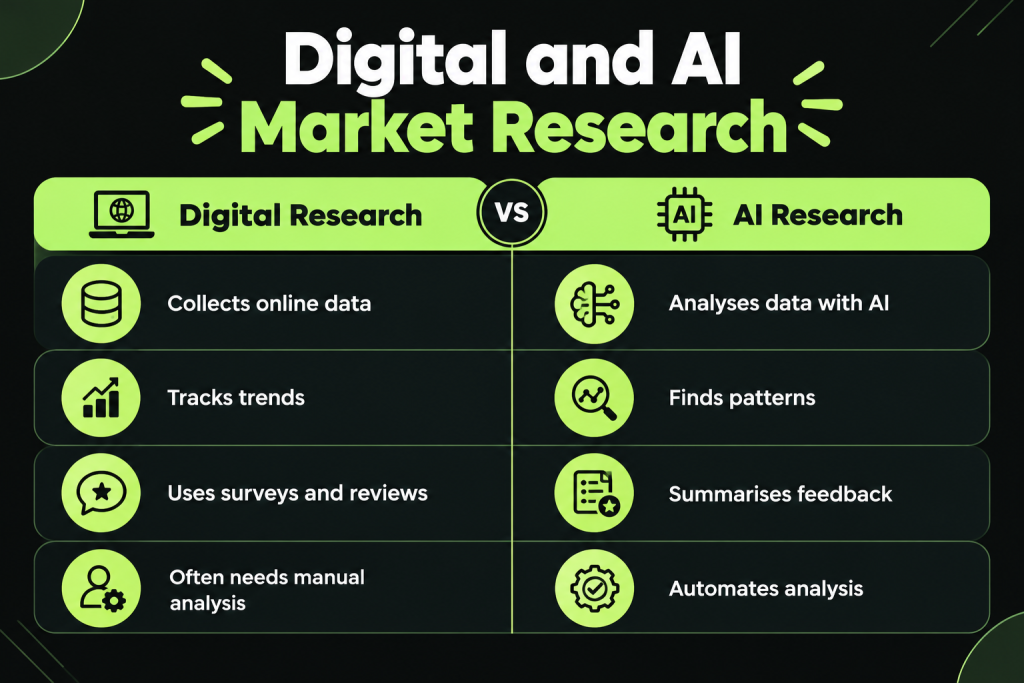 Digital market research relies on online data for quick and cost-effective customer analysis. Firms use web behaviour, trends in search engines, social media activity, online surveys, and customer reviews for customer insight into their needs and interactions. Since this type of research data updates all the time, it can be helpful in detecting changes in demand.
AI market research is an advanced form of digital market research. It allows one to:
- Analyse extremely large amounts of data and find trends that might be missed
- Summarise thousands of customer comments
- Classify customers according to their behaviour
This approach speeds up the process and gives the possibility of scaling the analysis for smaller groups. To see how AI is reshaping search itself, read our guide to the future of SEO.
However, artificial intelligence is a helping tool. Human verification is necessary for guaranteeing that results are accurate and not deceptive, respecting customer privacy, and making evidence-based decisions.
Concept Testing in Market Research
The process of concept testing helps you test your assumptions about a product, advertisement, design, or service before putting it on the market. This helps you avoid launching first and hoping for success by checking the concept with a small group of your target customers
For example, a small company has decided to produce a reusable water bottle with a filter in it. In this case, before production, the company can present to its potential buyers a drawing, description and price, and ask whether the cost and the bottle itself are attractive enough.
Examples of Market Research in Business
Here are some cases in which the particular method helped in making a decision.
1. Fashion brand: survey and social listening
A fashion brand carried out a survey among 400 clients and, atthe same time, ran social listening for two months. As a result, it found that six out of ten people would pay more for sustainable materials. In addition, many customers complained about the excessive amount of wrapping material used. Therefore, the brand launched an eco-line of clothing made of organic cotton and packed in reusable wrapping material.
2. Local restaurant: competitor research
The owner of the local restaurant researched eight other competing restaurants’ menus and prices, as well as clients’ reviews. They didn’t have any menu with vegetarian food options, and that is why their clients left negative reviews about it. The owner put six vegetarian dishes on the menu.
3.Software Company: Customer Interviews
The software company interviewed 12 customers about their first-week experience. These customers said that they were having trouble completing the account setup process. In order to solve this issue, the software company decreased the stages for account setup from seven to three. This “why” cannot be determined with just numbers alone.
4.Online Store: Concept Testing
Before launching their website, the online store tested two product page designs among 200 potential buyers. Design B (which offered more information on pricing and delivery) was preferred by most respondents. The online store used design B and thus didn’t build the wrong page.
“Insights like these also shape how a business positions itself, which we cover in our guide to brand management in the digital era.
Which Research Method Should You Choose?
It all depends on your purpose, so choose an appropriate method for your research objective.
Identify market gaps and positioning.Comparing prices and services of local restaurants
| Method | Main Purpose | Suitable Example |
| Online surveys | Collect opinions and preferences at scale. | Surveying 300 customers about their favourite flavour |
| Interviews | Understand motivations in depth. | Finding out why a customer switches brands |
| Focus groups | Gather group reactions. | Testing reactions to a new brand logo |
| Observation | See real behaviour in practice | Watching how customers move around a store |
| Competitor analysis | ||
| Concept testing | Test ideas before launch. | Showing a product concept to potential buyers |
| Web and social media analytics | Track online behaviour and trends | Seeing which pages lead customers to buy |
Not sure how to run a competitor analysis? digital marketing consultant can help you spot gaps and position your business.
Role of a Market Research Analyst
The role of a market research analyst is to use knowledge for guidance. To begin with, the tasks usually include conducting research and collecting information. Next, the analyst studies customer behaviour in order to understand what people buy and why. Likewise, identifying market trends helps the business prepare for changes in demand. Meanwhile, monitoring competitors reveals both risks and opportunities. In addition, the role involves giving reports and suggesting solutions. Therefore, managers can rely on the analyst’s findings to make better decisions
A good market research analyst should have technical skills such as statistical and technological skills, as well as curiosity and communication skills. If you want to build these skills, Digital Usman’s digital marketing course covers research, analytics, and strategy step by step. Although a small business would not afford a full-time analyst, somebody would have to be responsible for the process.
How Digital Usman Helps Businesses Make Better Marketing Decisions
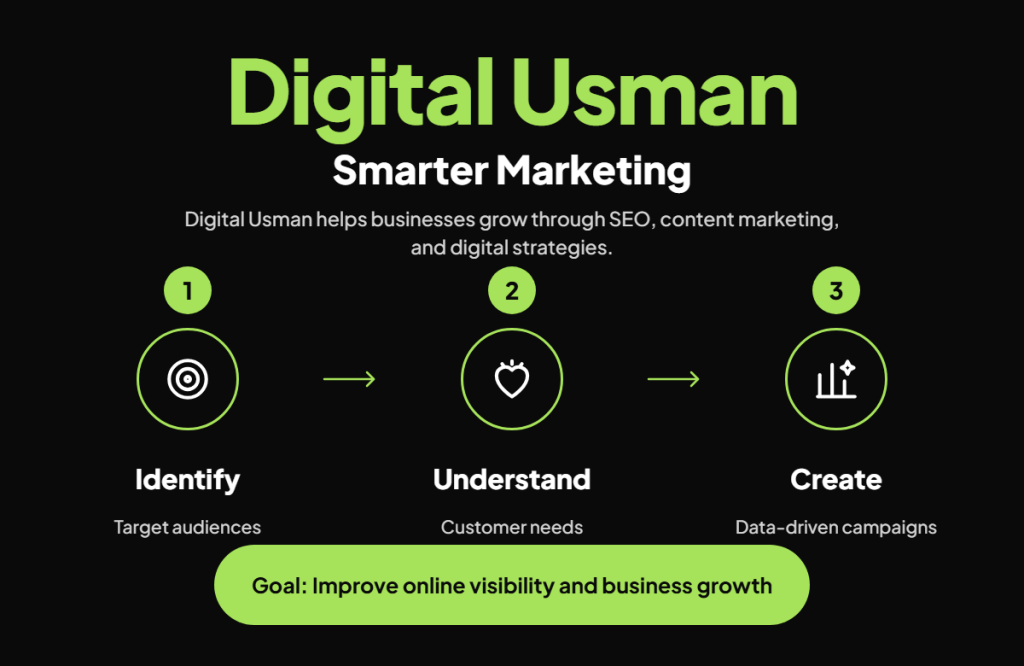
Digital Usman is an agency that offers Digital Marketing services to companies that strive to improve their online presence via SEO, content marketing, and other Digital Marketing Strategies.
Data-Driven Approach
Knowing your customer is the first step in this process. Digital Usman takes into account the following factors while launching its campaign:
- Who is your target audience?
- What are the interests of your target audience?
- What are the factors influencing the decision to make a purchase?
Thus, the content and campaigns are created around the needs of your customers, not your assumptions. No research guarantees success, but decisions backed by data are far more reliable.
Conclusion
Market research provides a reliable approach to understanding customers before making investments. First, using both primary and secondary research methods helps you gain valuable insights and make informed decisions. Additionally, choosing between qualitative and quantitative research and following the proper market research steps can help reduce risks and identify new opportunities. Moreover, digital technology and AI can deliver faster results. However, human analysis remains essential for verifying information and ensuring accurate conclusions.
The most important practical takeaway from this guide is simple: don’t make any moves unless you have facts to support your decisions. Therefore, conduct market research before launching a new product. Need help turning customer insights into a marketing strategy? Contact us today and let Digital Usman guide your next step.