

Summary: A guide to understanding what market researchers do, including their day-to-day activities, skills, career prospects, salary, and the qualities needed to become one. Learn how market researchers gather and analyse data to identify customer needs, industry trends, and competitors.
A Complete Guide to Market Researchers: Their Job Roles, Skills and Salary
Market Researchers are vital in helping a business get to know its customers, competitors, and market trends. They gather data, analyse purchasing behaviours and market trends to help a company make better business decisions.
Reliable research helps to decrease the amount of uncertainty when launching a new product, entering a new market, or improving your marketing strategy. Businesses within various industries across Pakistan use research and data analysis to help spot opportunities and see what their customers expect. These industries include Retail, Technology, Banking, Real Estate, and E-Commerce.
In this guide, we will look at what a Market Researcher’s job involves, what duties they perform daily, the skills & qualifications required, types of research, career opportunities, and salary expectations within Pakistan.
What Are Market Researchers?
A Market Researcher will gather, analyse, and interpret data in relation to a specific market. They will have the main duty of understanding customer requirements, buying habits, market demand, and competitor activity.
 They help businesses answer important questions, such as:
- Who are your customers?
- Which products/services are they looking for?
- What will they be willing to spend?
- What are competitors providing?
- Is there enough demand for your new product?
- What impacts their decision to purchase?
This helps the company decide on what products to offer, who they should be targeting, and how to position their product.
What Do Market Researchers Do? Key Roles and Responsibilities
Market researchers have various roles within their industry, company, and research goals, but their main role is to analyse data to help businesses.
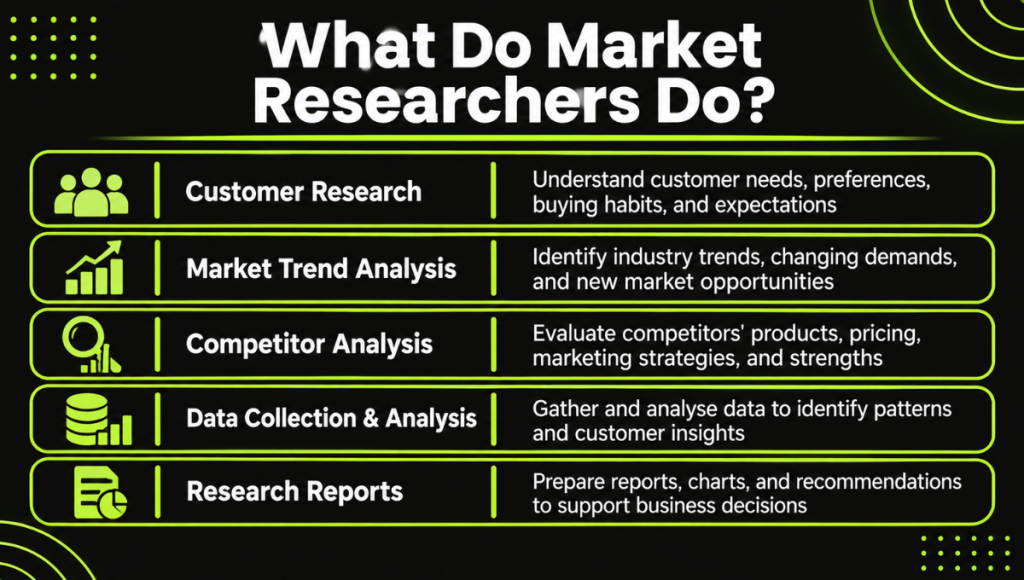
1. Conduct Customer Research
Market researchers will look at what their customers expect, like, and are interested in, and how they purchase. They can do this by completing online surveys, interviews, feedback forms, and discussions.
2. Analyse Market Trends
Monitor industry trends, changes in customer tastes, new market opportunities, etc., by looking at current reports, trade magazines, sales data, and web-based data.
3. Perform Competitor Analysis
Research competitors to determine what they sell, how much they charge, their marketing methods, and to see what their key strengths and weaknesses are.
4. Collect and Analyse Data
They collect data from various sources and format it into useful data sets. They use tools such as spreadsheets, statistical programmes, and visualisation tools to identify patterns in the data.
5. Prepare Research Reports
Once the analysis has been done, they create reports, charts, presentations, and recommendations to explain what the data means and how businesses can use the data.
What Are the Different Types of Market Research?
Market research can be broken down into different types. These types depend on what information you want to gather.
 Primary Market Research
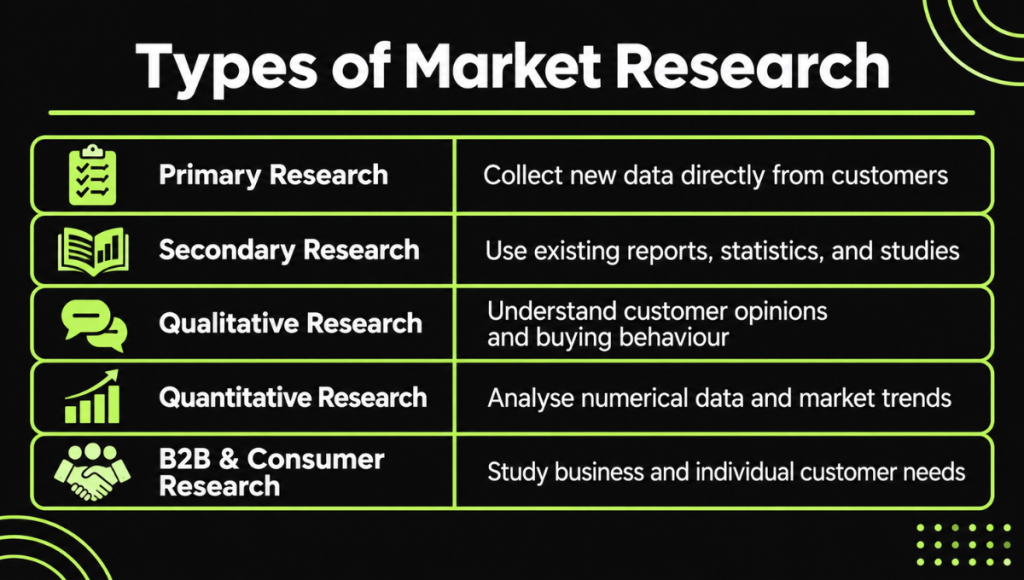
Primary – This is when you carry out research to get new information from customers, businesses, or others who are involved.
Common examples include:
- Internet Surveys/Polls
- Individual interviews with customers
- Focus groups
- Product testing
- Customer feedback
Provides targeted information, may take longer to plan and conduct, and can be resource-intensive.
Secondary Market Research
When carrying out secondary research, pre-existing information is used. Data is gathered from various places such as reports, official statistics, industry research, company websites, and research publications. This can be a quick way of gaining useful background information.
Qualitative Market Research
Qualitative research is about views, feelings, reasons, and behaviour of customers. It helps you understand why people make certain decisions. Common types of qualitative research would include interviews, focus groups, and open-ended questions.
Quantitative Market Research
Quantitative research is numerical and measurable. Common methods would include surveys, structured questionnaires, sales data, and statistical analysis.
B2B and Consumer Market Research
B2B market research involves researching businesses as customers using different market research techniques. This includes analysing industry demand, purchasing processes, business problems, decision-makers, and competitors. These techniques help businesses better understand their target market.
What Are the Most Common Market Research Methods and Techniques?
Many methods and techniques can help researchers obtain accurate information. Choose the right method based on your research question, available resources, and target audience.
| Research method | How it works |
| Surveys | Collect structured responses from customers. |
| Interviews | Explore individual opinions and experiences. |
| Focus groups | Gather feedback through group discussions. |
| Observation | Study how people interact with products or services. |
| Competitor analysis | Compare competing businesses and their strategies. |
| Data analysis | Identify patterns in sales, customer, and industry data. |
How to Do Market Research: A Practical Process
Follow the steps below to help you carry out useful market research:
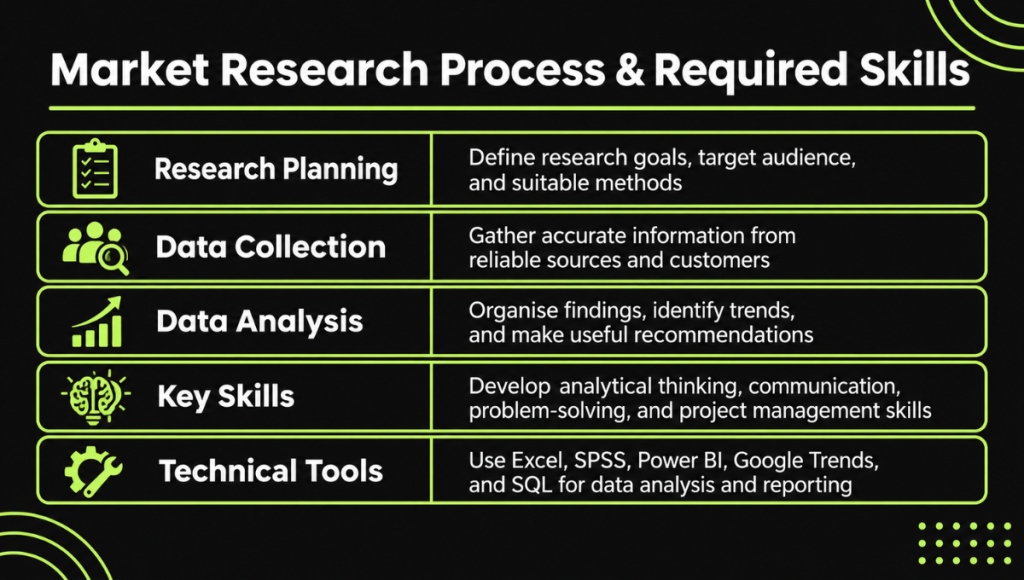
- Define what you are trying to find out.
- Decide who your target audience is.
- Set up a method of research (Surveys, interviews, secondary research, etc.)
- Gather relevant information from credible sources and people.
- Organise this information to find key trends.
- Make recommendations to show how your findings can help a business come to a decision.
This will help businesses make well-informed decisions using credible market research.
What Skills Do Market Researchers Need?
To be a successful market researcher, you must have a good set of skills.
Some key skills are:
- Ability to evaluate information (analytical)
- An ability to communicate findings of your research
- Ability to analyse data
- Ability to identify any issues that could affect the business
- Ability to check for any mistakes in information
- Ability to critically evaluate sources
- Ability to manage projects
- Ability to understand what drives customers to make a purchase.
Technical Tools and Software
You may also be expected to understand some of these tools.
- Microsoft Excel/Google Sheets – Data organisation and calculation
- SPSS – Statistical analysis
- Power BI/Tableau – Dashboard and visual reporting
- Google Trends – Search trends
- Survey tools – Questionnaire creation and customer feedback collection
- SQL/Python – Data management and analysis of larger sets of data.
While you may not be expected to know these tools well in an entry-level role, having a good understanding of Excel, research methods, and basic data visualisation will give you a good start.
What Qualifications Do You Need to Become a Market Researcher?
Most employers will look for someone who has a bachelor’s degree in Marketing, Business Administration, Economics or Statistics, Mathematics, Psychology or a related subject.
Depending on the role, a market research analyst with a different educational background may also have the flexibility to undertake entry-level research and data collection roles.
For beginner research roles, it can be useful to:
- Learn fundamental research methods and data analysis
- Gain Excel and presentation skills
- Practice designing surveys and analysing responses
- Research actual businesses and their competition
- Create some sample research reports to add to your portfolio
- Apply for internships and junior research roles
By completing some practical projects, you will be able to demonstrate that you understand how to gather information, critically analyse sources, and provide useful results.
Market Researcher Salary in Pakistan
Salaries for researcher jobs in Pakistan can vary depending on experience, technical skills, industry, and job role.
Market Researcher Salary in Pakistan
| Category | Experience / Location / Company | Average Monthly Salary (PKR) | Estimated Annual Salary (PKR) |
| National Average | Overall Market Average | 231,600 | 2,779,342 |
| Experience Level | Entry-Level (1–3 Years) | 169,230 | 2,030,779 |
| Experience Level | Senior-Level (8+ Years) | 271,540 | 3,258,529 |
| Future Forecast | Estimated 5-Year Growth | 318,740 | 3,824,900 |
| Major Cities | Karachi | 59,141–249,285 | 2,991,425 |
| Major Cities | Islamabad / Rawalpindi | 38,797–239,190 | 2,870,333 |
| Major Cities | Lahore | 52,785–70,000 | 840,000 |
| Major Cities | Multan | 38,530 | 462,360 |
| Companies | HRSG | 95,000–104,000 | — |
| Companies | IDR | 61,000–84,000 | — |
| Companies | S&P Global | 45,000–63,000 | — |
| Companies | ECademy (Pakistan) | 48,000–52,000 | — |
| Companies | TCS Express & Logistics | 39,000–42,000 | — |
This is an estimate based on information from various sources. Your actual salary will depend on your experience, job title, employer, and location.
What Affects a Researcher’s Salary?
Several factors will impact how much you could earn as a researcher:
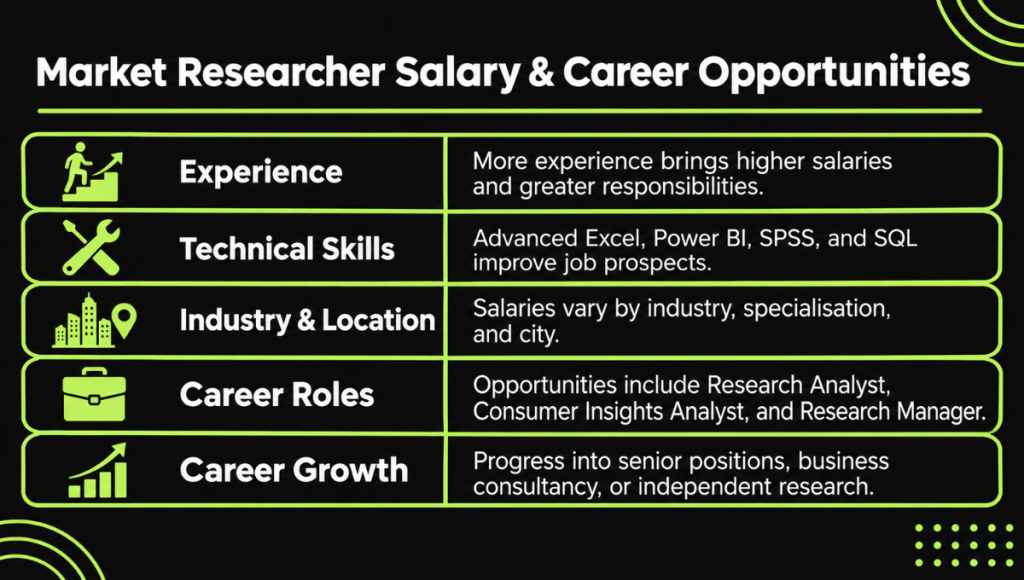
- Experience: Those with experience will be able to take on more complex projects and higher research responsibilities.
- Technical Skills: Those with advanced Excel, Power BI, SPSS, SQL, and statistical analysis skills will have better job prospects.
- Industry: Some industries will be specialised, and you may need extra technical / business skills.
- Location: Earnings can differ depending on whether you work in Lahore, Karachi, Islamabad, or other cities.
- Responsibilities: You may earn different amounts depending on whether you are collecting data or a strategic analyst.
Salary websites will vary in terms of their sample and calculations, so take average salaries and specific vacancies as a guide only.
What Career Opportunities Are Available for Market Researchers?
Market Researchers can work within a variety of different industries and can take various career paths.
Some common job titles are:
- Market Research Assistant
- Junior Research Analyst
- Market Research Analyst
- Consumer Insights Analyst
- Business Research Analyst
- Research Executive
- Senior Research Analyst
- Market Research Manager
Typical employers of Market Researchers are research agencies, advertising agencies, consultancies, financial institutions, technology companies, e-commerce companies, and in-house research departments.
With experience, they can progress into senior analyst roles, research management, business consultancy, or as an independent researcher.
What Are the Advantages of Market Research?
Market research allows companies to make:
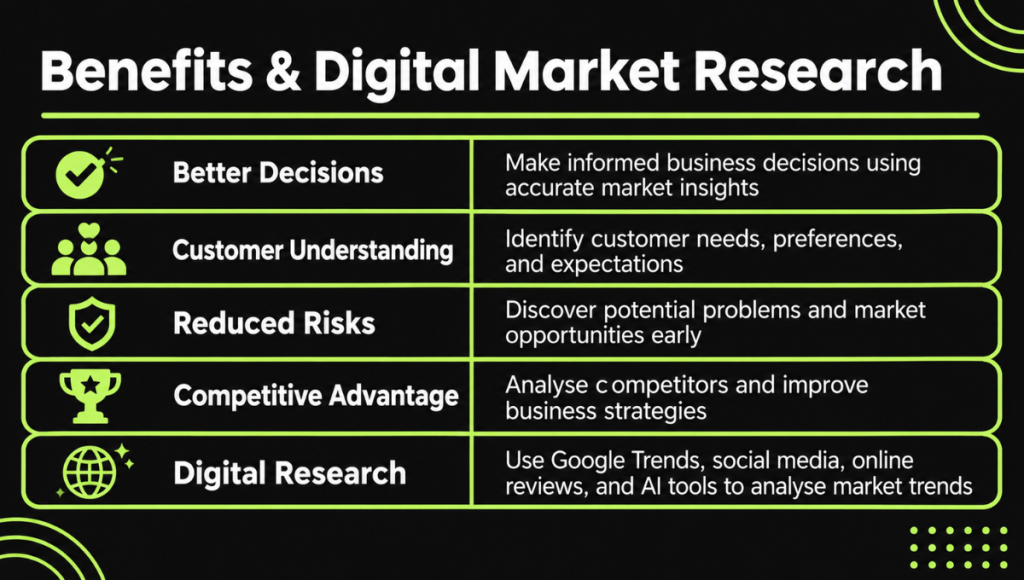
- More informed decisions.
- Better knowledge of customers.
- It will tell you what your audience requires.
- Minimises risk.
- Will allow you to see any potential problems.
- Better product.
- Customer feedback will show you what improvements are needed.
- Better marketing strategy.
- Companies can find out who their target audience is and what methods will best reach them.
- Competitive edge.
- Analysing competitors will show you areas where you are lacking.
- Better planning.
Having knowledge about the market will help you decide on pricing, product, and expansion.
However, the data must be accurate, relevant, and properly analysed. If your sample isn’t good or your questions are biased, then your results may be misleading.
Digital Market Research: How Is Technology Changing the Field?
Digital market research refers to researching your customers, competitors, and market using online tools.
You can analyse your website and search data, social media conversations, online reviews, customer feedback and digital marketing performance.
Using Google Trends, a business can gain insight into how interested people are in a certain product category, and analyse competitor websites to see how they are positioning themselves.
However, AI tools can help when organising information, condensing responses, and finding patterns. Ensure you check that the information is accurate, keep customer data safe, and do not rely on the AI to conclude anything without evidence.
How Digital Usman Supports Digital Business Growth
Understanding your customers and market trends is an important part of creating effective digital marketing strategies. Digital Usman can help your business improve its presence by providing you with digital marketing expertise and services.
SEO and Competitor Research
SEO research gives you insight into what your potential customers are searching for online. By carrying out keyword research, competitor research, search intent analysis, and website analysis, you can find opportunities to bring relevant traffic to your business.
Content Marketing and Audience Insights
Gain insight into what your customers are asking and what they are interested in. This can then be used in a content marketing strategy to provide targeted blog posts, webpages, etc.
Data-Driven Digital Marketing
Using digital marketing analytics will allow you to track how people are interacting with your website. By using this along with market research, you can make more informed marketing decisions.
For more practical insights into SEO, digital marketing, audience research, and business development, explore our blog. You can also learn about various things and digital marketing services.
Conclusion
Market researchers can help businesses gain useful insights into their customers and competitors. Market researchers will carry out research on customers, analyse the market, design surveys, interpret data, and provide reports.
To get into this career in Pakistan, it is best to start by improving your analytical thinking, communication, research, and technical skills. You can complete internships and research projects to gain experience.
Businesses can also benefit from this approach as they can improve their products based on the research, understand their audiences, and make informed decisions on their marketing strategy.
For help with market analysis, business strategy, or digital marketing, Contact Us to discuss your goals.
FAQs
1. What is the difference between a market researcher and a market analyst?
A market researcher gathers data about the market. A market analyst analyses the data to find patterns, trends, and opportunities.
2. Is market research a good career in Pakistan?
Yes! There are many opportunities in marketing, consulting, tech, financial, and e-commerce industries. If you have strong analytical skills, they can help boost your career!
3. How can beginners learn market research?
As a beginner, you can get into market research by practicing Excel, basic statistics, surveys, customer research, and competitor analysis on real examples from businesses.