
Summary: The tutorial offers insight into the AI SEO definition, how the development of artificial intelligence changes search workflow processes, and the necessary competencies to be developed. You will be guided on how to leverage AI technologies properly and create the learning path successfully.
AI SEO: Mastering Key Skills for Better Search Rankings
What is AI SEO? | SEO | Keyword research
The search process has changed more in recent years than in the past decade, and AI SEO is at the centre of that shift. AI answers are the top choice among all traditional answers. Chatbots provide a general idea of what is available online even before one clicks on anything. What used to take half a day, such as keyword sorting and creation of content outlines, can now be completed in just a couple of minutes.
That is why it is vital to have skills in AI SEO nowadays. It is no longer enough for the company to ask you whether you can rank their website; they also need to know whether you are able to work with AI, to evaluate its performance, and to ensure that your website will be seen not only during traditional search but also during AI search. A person who knows at least something about SEO and AI has obvious advantages.
In this article, we will learn what AI SEO is, what skills it requires, how it differs from traditional SEO, and how to obtain such skills without making some particular mistakes.
Quick Answer: AI SEO entails the use of AI to expedite processes such as keyword research, content briefing, auditing, and optimisation while ensuring that the content is structured to be discovered, understood, and cited by AI-driven search engines. The necessary skills to learn include SEO writing through AI, AI optimisation, keyword research, competitor research, and SEO audits.
What is AI SEO?
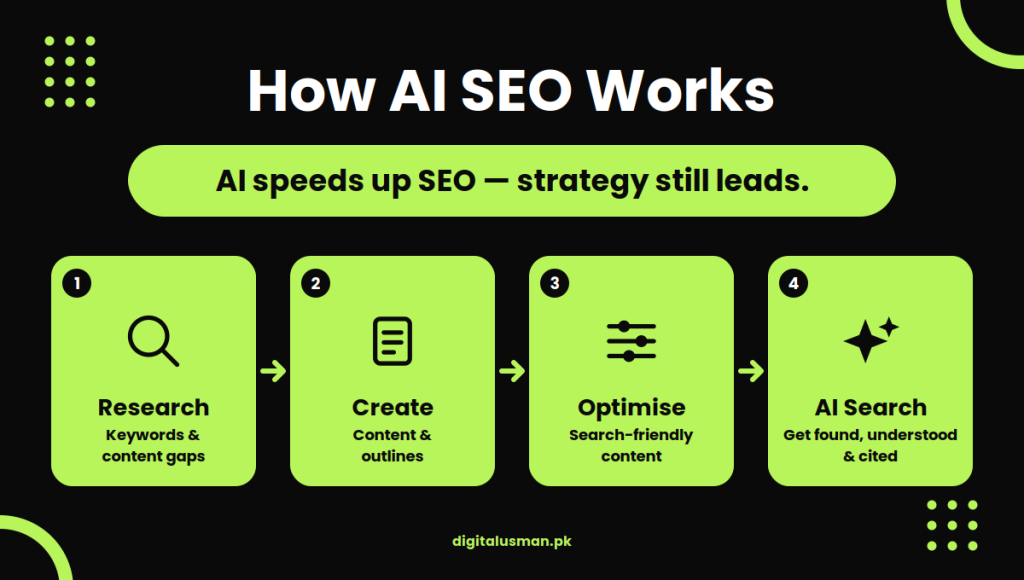
First, AI SEO is a process of using artificial intelligence in researching, producing, optimising, and measuring content for search. Second, AI SEO is the optimisation of the content so that search based on AI will find, understand, and cite it.
The first definition is associated with the work. AI helps in analysing the big number of keywords, discovering content gaps, producing an outline and solving technical issues. The second definition refers to the notion of visibility. The AI assistant gets certain questions, and the content needs to be optimised in such a way as to be used as an answer to these questions.
AI does not replace the strategy of SEO but makes routine tasks faster, providing more time for thinking and creativity.
How AI is the Game Changer in SEO
The impact of AI on SEO can be felt in every single step of the way. Search engines have evolved too, and now there is AI-driven summarisation, conversational answers, and more advanced kinds of answers. While rankings still matter, a mention in the AI-powered answer is a new goal to achieve. The following are just a few workflows that are being redefined due to AI:
- Keyword research: It used to be about exporting spreadsheets and doing manual sorting. Thanks to AI, you can cluster thousands of queries by topic and intent in just seconds.
- Content briefs: What took an hour is now done in minutes.
- Audits: No need for manual crawling; there is automation and prioritisation of fixes instead.
- Search results: Visibility is not only about ranking; it is also about citation.
It means that speed is not a differentiator anymore since everybody has the same technologies. The quality, accuracy, and uniqueness of the SEO work are what matter today.
Essential AI SEO Skills to Master
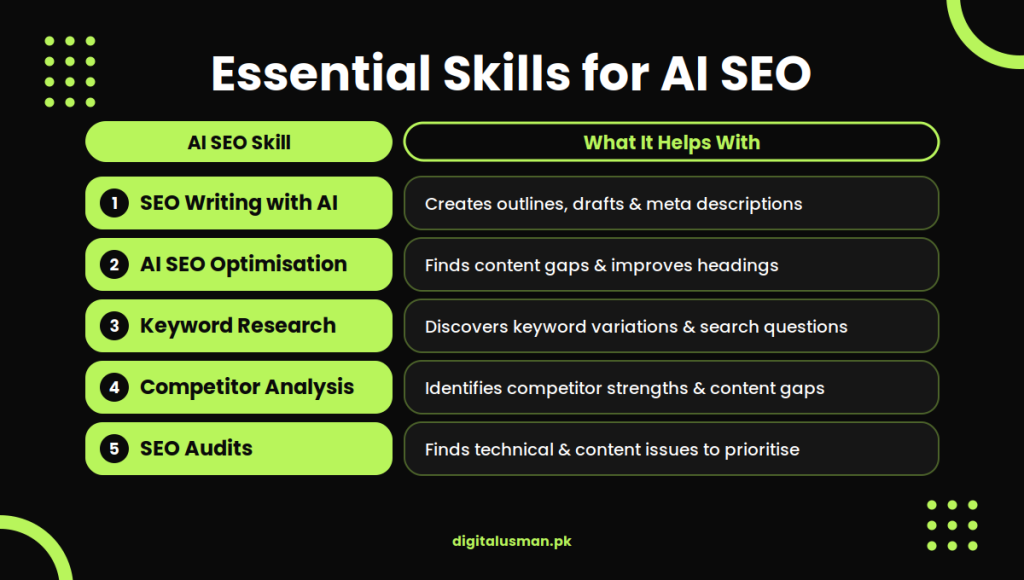
SEO Writing with AI
SEO AI programmes can create an outline, drafts, and meta-descriptions within a few minutes if you give them the target audience, objectives, and sources.
The ideal SEO writing AI should think in a human way. Use personal life examples and figures which cannot be created in the AI prompt.
AI SEO Optimisation
SEO AI optimisation is when one uses AI to optimise not only the existing pages but also the future pages. This is when one can ask the tool to compare one’s page to the best pages and show all the missing subtopics, as well as give advice on better headings.
The most important thing is to test the suggestions, as AI suggestions are just hypotheses.
Keyword Research
The SEO process begins with keyword research, which has been made very easy by AI. Using the AI algorithm, we get hundreds of keyword variations that are created by the seed keyword and then organised according to their themes. The tool also provides long-tail questions that people ask during their searches. To get an in-depth understanding of manual and AI-assisted keyword research strategies, refer to our beginner’s guide on-page SEO.
However, search volume is not all that matters because you have to consider whether the keywords are relevant to your business and whether you can rank for them.
Competitor Analysis
Competitive analysis helps you to know what works for your competitors and where they lack. This AI can assist in analysing the structure of other websites, their topics, and what they have not done.
Use the information to make yourself stand out among your competitors rather than imitating them. If all the top results focus on five things, then your unique feature will be the sixth thing or better coverage of the first five.
SEO Audits
The SEO Audit measures the technical performance, content performance, and authority indicators of the website. The AI helps to analyse the data collected and classify the problems based on their importance and problem description.
A good auditor will still have to choose what problems should be fixed first. Having a broken canonical tag for your highest-revenue-generating page is much more important than missing alt tags for one of your blog post images.
AI SEO Skills Compared: Roles, AI Support, and Human Review
| Skill | How AI Helps | Human Check Needed | |
| Search intent | Categorises search intent based on large numbers of keywords | Verifiable by reviewing the live results | |
| Content optimisation | Evaluates the content and provides suggestions | Evaluation of readability and usability. | |
| Technical SEO | . Highlights errors and corrects them | Do not make mistakes under any circumstances. | |
| GTmetrix and Performance | Test analysis | Repeat the test after every change. | |
| Schema markup | Facilitates JSON-LD creation fast
. |
Test the markup. | |
| SERP Analysis | Trends in the Search Results | Their Importance to Your Content. | |
| Backlink analysis | Segments prospects and performs outreach. | Value and networks are key. | |
How AI Supports Common SEO Tasks
AI is involved in all stages of the SEO process, from research to reporting. The fact that AI is able to perform all routine tasks quickly means that there is more time for planning and creating. Here is how it can help you:
- Keyword research: AI groups and expands the queries by topics and intents, thus offering long-tail keywords.
- Content writing: AI creates the outline and first draft of the text according to the outline, thus saving you time on writing. To find out more about how to plan your content for conversions, see our guide to content marketing.
- SEO audit: AI analyses the crawl report and gives you recommendations on how to proceed with minimum effort.
- Competitor analysis: AI analyses the topic coverage of the ranking pages and discovers the content gap.
- Schema Markup: AI creates the schema markup templates, thus making the process faster.
- Reporting: AI analyses the performance trends in simple words.
AI Tools for SEO and Their Application
Currently, there are multiple AI tools for various SEO purposes, and each of them is perfect for its domain. The right choice of tools will help you boost productivity and save time. Here are some examples of applications:
- ChatGPT & Claude – content outlines, drafts, meta descriptions, and keyword clustering; proofread the results and add your personal touch.
- Semrush & Ahrefs – AI can be used for keyword research, competitor research, and backlink analysis, so you can discover new opportunities for linking.
- Surfer SEO & Clearscope – content scoring against top-ranking pages, missing topics detection; great for content optimisation.
- Screaming Frog & Google Search Console – crawling problems detection, SEO audit; AI will analyse all of that data for you if you are not an expert.
- GTmetrix – page speed and CWV reports; scripts and images that slow down your web page can be found with the help of AI.
The human brain is not going to be substituted, so all the advice should be double-checked before being implemented. This is what separates AI SEO from traditional SEO.
AI SEO Skills vs. Traditional SEO Skills
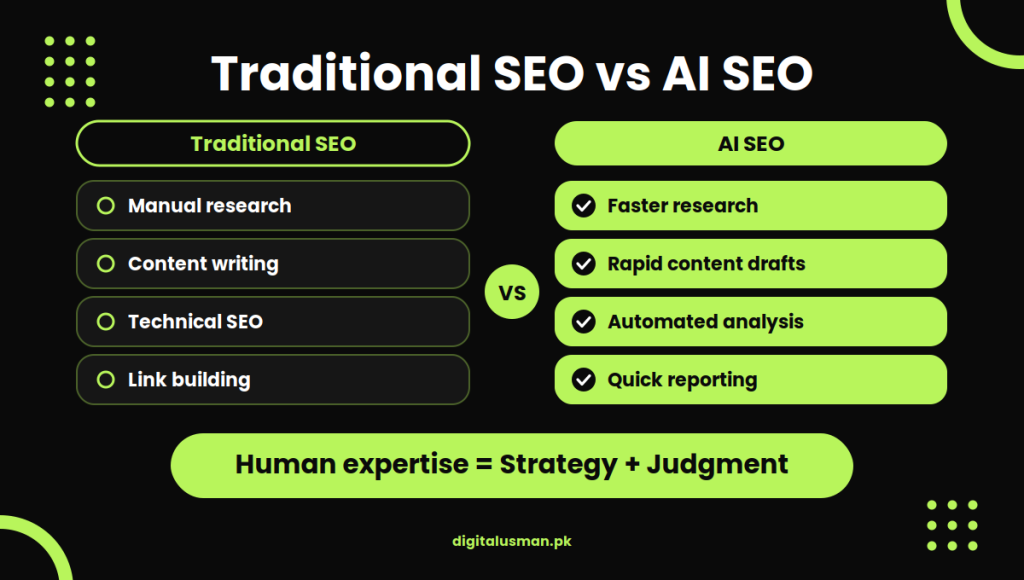
Classic SEO skills like choosing keywords, optimising websites, building links, and making technical changes are still relevant. Among the AI SEO skills are quick writing, evaluation of the outcomes, and automation of the process.
The key difference is that AI SEO is much faster, which is a huge plus. Nevertheless, AI SEO is more repetitive than classic SEO, which makes mistakes more common.
| Traditional SEO Skills | AI SEO Capabilities | Human Expertise |
| Manual keyword research | Automatic clustering and keyword generation | Selecting keywords based on business goals |
| Content Writing and Editing | Rapid Drafts and Variations | Achieving Uniqueness, Accuracy, and Voice |
| Technical troubleshooting | Error detection and analysis | Prioritising solutions and testing solutions |
| Link-building campaigns | Prospecting and message development | Building genuine relationships and quality evaluation |
| Reporting | Immediate summaries of data | Interpretations and recommendations for future actions |
How Beginners Can Develop AI SEO Skills
The development of AI SEO skills should be done gradually, and this is the best way for beginners to go about it.
Step 1: Start from the Basics
Get knowledge of crawling, indexing, and ranking of sites before utilising AI in your activities. Otherwise, it would be impossible to determine whether the recommendation of the AI was correct or not.
Step 2: Take Structured SEO Training
The best way is to learn about keyword research, on-page optimisation, technical SEO, and analysis one by one. Apart from this, you have to mix your practical experience with theory classes, such as making your own website/blog. Our comprehensive digital marketing course takes you through all these basics step by step, from keyword research to technical SEO.
Step 3: Use AI Tools in Your Project
Integrate AI into different aspects of your work, such as keyword clustering, outline creation, and website auditing. Then compare the outcome to your own assessment and see where the algorithm succeeds and where it fails.
Step 4: Keep Learning
Continually keep up with new search engine tools and utilise them on your platforms. Curiosity beats all the tools.
Finally, keep learning. There is constant evolution of search functionalities and platforms, and hence you must know which sources of information are reliable within the industry. The bottom line is curiosity, not the tools.
Common AI SEO Mistakes to Avoid
AI may help you work more efficiently, but its wrong use may harm your SEO ranking and your reputation. So here are some mistakes to avoid:
- Posting raw AI content: Raw AI content is always boring and sometimes even false. You need to verify facts and write your own analysis.
- Keyword stuffing: AI may use too many of the target phrases, which may sound unnatural. Write for the user and make keywords appear organically.
- Ignoring search intent: Even perfect writing won’t work if the content does not match the needs of the searchers.
- Using AI only: AI tools may give you false data or advice, so you need to verify everything.
Consider AI as an assistant rather than a replacement for yourself.
How Digital Usman Helps Businesses Grow with AI SEO
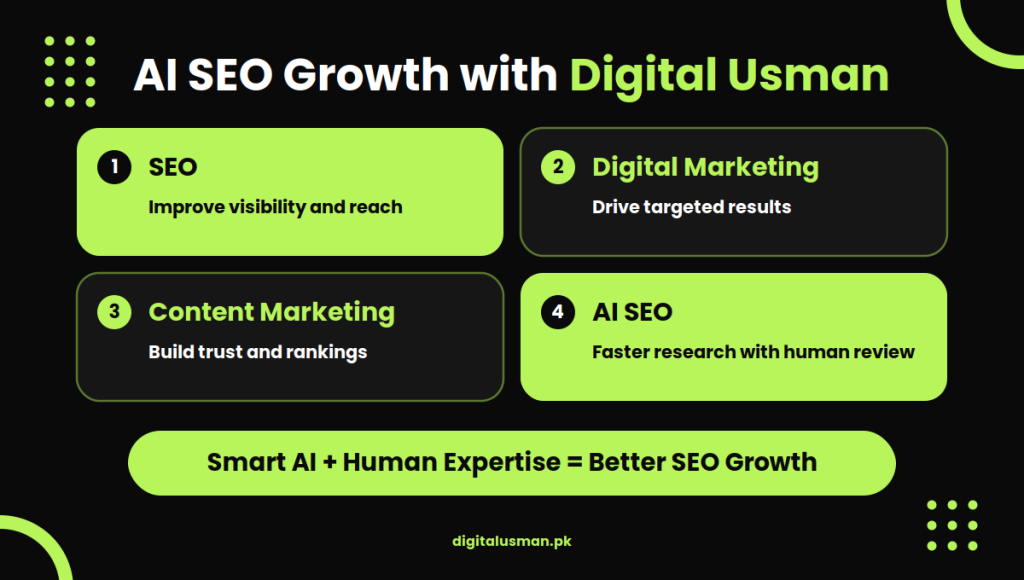
Modern-day search rankings require much more than using the appropriate technology. What it takes is a strategy, quality content, and consistent work. Digital Usman helps companies to achieve this by offering them SEO, digital marketing and content marketing services which rely on practical steps to boost growth. This is done through the research and optimisation of the campaign, which is then reviewed by humans to ensure that all campaigns are not only quick but also highly accurate and of high quality in accordance with the company’s brand.
What Digital Usman Offers
- SEO: Practical optimisation to raise visibility and attract an audience.
- Digital marketing: Campaigns focused on achieving certain outcomes.
- Content marketing: Practical and well-researched content to boost trust and rankings.
- AI-based SEO strategies: Quick research and analysis with human review.
Whether you are building a new website or are working on an existing one, Digital Usman can help you to reach your target audience and produce tangible results from it.
Conclusion
AI SEO is not the removal of the human expert. AI SEO is the combination of traditional SEO and technology for faster research, optimisation, and analysis. There are many SEO experts out there who know how to do keyword research, know search intent, understand technical SEO, write good content, and make use of AI for their work.
Start with basics, apply them in projects, and analyse everything that comes out of the AI. Those who can combine the human mind with AI will prosper in the future of search. Want expert help navigating AI SEO for your business? Get in touch with digital usman to build a strategy that works for your brand.
Frequently Asked Questions
What is AI SEO?
AI SEO means using artificial intelligence to speed up keyword research, content optimisation, and audits, while also optimising your content so AI-powered search can understand and cite it.
Can AI tools replace SEO professionals?
No. AI handles repetitive tasks well, but humans still need to review recommendations, verify facts, and decide what matters for the business.
How can beginners learn AI SEO?
Learn the SEO basics first, take structured SEO training, practise on a small website, and test AI tools while comparing their suggestions with your own judgement.